
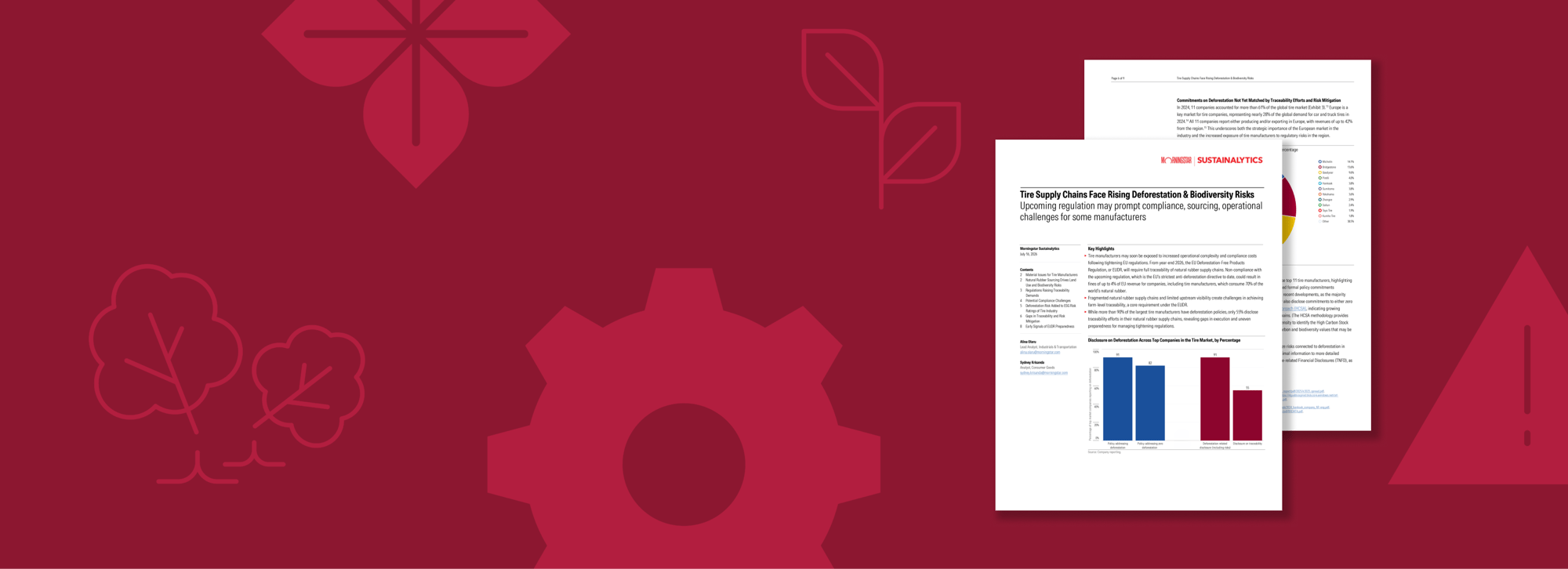
As natural rubber comes under growing regulatory scrutiny, tire manufacturers are confronting a new era of supply chain accountability.
The European Union Deforestation-Free Products Regulation (EUDR), set to take effect at the end of 2026, will require companies to trace natural rubber back to its origin and demonstrate that it is not linked to deforestation. For an industry that consumes more than 70% of the world's natural rubber, the implications are significant.
This report explores how tightening regulations, increasing biodiversity concerns, and persistent supply chain complexity are reshaping risk profiles across the global tire industry. Drawing on Morningstar Sustainalytics' ESG Risk Ratings research, it examines the challenges companies face in securing compliant natural rubber supplies, the competitive advantages of stronger traceability systems, and the growing importance of land use and biodiversity management in investor assessments.
In this report, you'll learn:
- How the EUDR could increase compliance costs, sourcing challenges, and operational risks for tire manufacturers.
- Why natural rubber sourcing has become a material land use and biodiversity issue for the tire industry.
- Which leading tire companies appear best positioned to meet emerging traceability requirements and manage deforestation-related risks.
- How Sustainalytics is incorporating deforestation and supply chain traceability into its ESG Risk Ratings framework for the tire sector.